Tuesday, December 27, 2005

It's Time For Progressives To Look Beyond the Ballot For Change

By MARC McDONALD

As America enters 2006, it's clear to many of us that this nation is in deep trouble.

Some progressives console themselves with the hope that perhaps the 2006 elections will return Congress to the Democrats' control. Other progressives are hopeful that support will grow for Bush to be impeached. Others are looking further ahead to the 2008 elections.

I know I stand the risk of being painted as an "anti-American" radical for saying this, but I'll go ahead and say it anyway. If we ordinary working Americans really want to take back our country, we really need to start looking beyond the ballot.

No doubt, Republicans will accuse people like me of seeking to overturn America's constitutional democratic system. This, of course, is a bogus argument. The fact is, the system has already been overturned by fanatical Bush loyalists.

In fact, America long ago ceased having the slightest resemblance to the original system that was envisioned by the Founding Fathers. No doubt, the Founding Fathers would be astonished at how America's political system has been thoroughly corrupted and tainted by money.

Indeed, if the likes of Thomas Jefferson returned today, he'd no doubt be absolutely sickened by the likes of Bush, a corrupt and evil politician who takes his marching orders from the rich, the powerful, and the corporations that dominate America today.

Incidentally, Jefferson had a few things to say about corporations in his day. For example:

"I hope we shall crush in its birth the aristocracy of our monied corporations which dare already to challenge our government to a trial by strength, and bid defiance to the laws of our country."

It's clear that the Founding Fathers, were they to return today, would in fact support a second American revolution---one that would sweep away the corruption that has infested our government and one that'd return democracy to the people.

To anyone who believes that this is simply too radical a step to take, I would like to emphasize that the Republicans have already bypassed our Constitution in their relentless drive to seize and consolidate their power the past couple of decades. Does any clear-thinking rational adult out there really believe that the 2000 and 2004 elections were legitimate?

The Republicans have already successfully gotten away with stealing two consecutive elections. Does anyone care to wager that they won't steal the vote yet again in 2008? I mean, what's going to stop them? The Democrats? (Don't make me laugh). The media? (Don't make me laugh even harder).

One thing I will give the Republicans credit for, though, is this: when they want something, they will relentlessly focus on getting it, no matter what the cost. By contrast, the Democrats have utterly failed in their role as the nation's opposition party.

With a few exceptions, the Democrats are weak and timid. Democratic candidates for office are simply too polite and they're always careful to follow the rules and to not upset or offend anyone.

By contrast, Republicans go into elections like street fighters. A lot of today's Republicans follow no rules in elections. They won't hesitate to use a pair of brass knuckles, or pull a switchblade out of their sock and stab you in the back. And in the end, if they lose the election, that's OK---they'll simply steal the vote.

As bad as Bush is, I have no doubt that the next guy the Republicans run for president in 2008 will be even more extreme and more evil. I mean, Bush makes Reagan look like a moderate (and, by contrast, Nixon was a downright liberal compared to Reagan). So you can imagine the horrors that face this country in the years ahead.

So how can we, the working people of America, really change things, going up against the Republicans and their billions of dollars in backing from the rich and powerful? The traditional checks and balances in our nation's system simply are no longer there.

Once upon a time, corporations were actually controlled somewhat by a few rules here and there---they weren't allowed to run amok with unbridled power as they are today. Once upon a time, our nation's media actually performed a watchdog role---unlike today's timid, cowardly media, where the likes of Bob Woodward and Judith Miller actually collaborate with the White House.

As far as the impeachment process goes, I don't have much confidence that today's Democrats have the spine to hold Bush accountable for his crimes. I mean, the Democrats are so timid these days, they don't even contest blatantly stolen elections. How can we expect them to ever take such a bold step as to impeach Bush?

No, if you really want true, genuine change in America these days, the only way to do it is to look beyond the (stolen) ballot. People are going to need to take to the streets and demand change if we're ever going to get it in this country.

Maybe we could take a cue from our nation's past progressive history and organize a nationwide general strike. In any case, people power is capable of wonderful things: look at how peacefully protesting masses played a crucial role in bringing down the Eastern Bloc communist states without a shot being fired.

Thursday, December 15, 2005

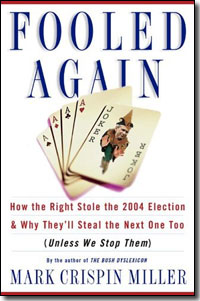
"Fooled Again" Author Mark Crispin Miller: Why American Democracy Is In Danger

By MARC McDONALD

In the following interview with BeggarsCanBeChoosers.com, author Mark Crispin Miller talks about his new book, Fooled Again, which takes a look at the 2004 election. In this interview, Miller describes how America's current election system is "rotten to the core." He explains why American democracy is finished if the nation doesn't implement serious electoral reform immediately.

In a nutshell, what is your new book, Fooled Again, about?

Miller: The theft of the 2004 election. The book provides an overview of all the many tactics and devices that were used nationwide--indeed, worldwide--to cut the Kerry vote and pad the Bush vote. It's also an analysis of the fanatical mentality behind that vast crusade against American democracy.

What motivated you to write this book?

Miller: A sense of civic outrage, not only at the fraud itself but at the general silence over it. With just a few exceptions here and there, the whole political establishment, the press included, steadfastly refuses even to acknowledge the grave danger of election fraud.

If we don't have serious electoral reform ASAP, American democracy is finished; and yet both parties and the press are largely unified in deeming last year's race legitimate. So there's been next to no debate over a major danger to American democracy, and, therefore, to our very lives and liberty.

That silence is a grave betrayal of American ideals, and an insult to common sense, and I wrote Fooled Again to break it.

At what point did you first become aware of problems in the 2004 election?

Miller: Big problems were already popping up before Election Day--not just in Ohio, but in Pennsylvania, Florida, Minnesota, Texas and a lot of other places.

There was evidence of a concerted effort to disenfranchise Democrats by using fake opinion pollsters in Nevada, Oregon, New Jersey, West Virginia and elsewhere. There were intimidation tactics, blunt obstructionism, state disinformation drives, and even break-ins, all over the country.

There was interference with the huge vote of Americans abroad. All such evidence was on the public record--not in any prominent place, but out there on the record--prior to Nov. 2. After Bush & Co. miraculously won, all memory of those problems seemed to disappear completely from the national radar screen.

Did you encounter many obstacles in writing this book? For example, did you find that officials were reluctant to talk, or that records were difficult to obtain?

Miller: A lot of evidence was missing when I wrote the book and is still missing now.

For instance, we still don't have the raw precinct-level data that was used by the official exit pollsters. The media corporations that paid for it won't make it available to independent scholars. And certainly the politicians and the bureaucrats, the party operatives and corporate personnel, observed a stubborn silence on a broad range of electoral concerns.

Across the board, Republicans refused to answer questions; and a lot of Democrats were strangely eager not to talk about the numerous anomalies, contradictions, improprieties. Such stonewalling was a given, something that you had to work around.

The evidence in Fooled Again comes either from the public record, or from people not afraid or disinclined to tell the truth.

The mainstream media in this country have been reluctant to examine problems with the 2004 election. Why do you think this is?

Miller: The U.S. media does not provide the crucial civic service that the Framers had in mind when they extended constitutional protection to the press.

The U.S. press today, in other words, does not inform the people for the purpose of republican self-government. It answers not to us, but to its parent companies, their shareholders and advertisers, and, not least, the government, which keeps the cartel well-protected from the people.

Whereas America's free and independent press was meant to function as a major part of our great system of checks and balances, and thereby help to keep us free from state dominion, the juggernaut that we now call "the media" is itself an instrument of such dominion. It does not report the news so much as it determines which news is, and which news isn't, beneficial to those managing the state. (By and large, this process works not through conscious and deliberate policing from on high, but far more subtly, through the fears and needs and aspirations of the people working in the media at every level.)

This is why the U.S. press will not report whatever news might pose a threat to the political establishment. It's why they never did report the truth about Bush/Cheney's drive for war against Iraq, even though there always was abundant evidence against the claims that Bush & Co. were making. It's why they've quickly veered away from every story that, if followed through, could well have blown the Bush regime to smithereens: 9/11, Gannongate, Katrina.

And, worst of all, it's why the press refuses to report the ever-worsening condition of American democracy: last year's election fraud; the current push by Diebold to get its DRE machines into more precincts coast to coast, despite a growing wave of popular resistance; the mammoth money-laundering operation that was used to pay for the subversion of the race last year; the Bush regime's attempts to gut the Voting Rights Act; and so on.

Do you believe that our nation's election system problems will be fixed in time for the 2006 elections?

Miller: There simply isn't enough time. We do have time to get a good start on improving things considerably by 2008. Before the next election, there is time to organize a national grass-roots polling operation in the most important places. Such an effort--which ought to be bipartisan, or non-partisan--would at least provide us with a rough idea as to how accurate the final vote-count really is.

In the meantime, we must do everything we can to force the scandal of last year's election out into the light of day. Once people know what really happened, they will demand electoral reform, and then we can debate how best to do it. If, on the other hand, the people keep on thinking, or half-thinking, that that election was legitimate, reform will seem unnecessary.

"If it ain't broke, don't fix it." We have to tell the nation--and the world--that things are badly broken here. If we do not, American democracy will soon be past repair.

I'd imagine that, after reading your book, there will be many alarmed citizens out there who will be wondering what they can do to help ensure honest elections in the future in America. What would be your advice to them?

Miller: The effort must be local as well as national. Those concerned should learn about the voting system where they live and vote (or try to vote), and work to make it as efficient and transparent as possible.

There are currently aggressive efforts under way to get Diebold machines approved, or their use extended, in New York, Pennsylvania (Bucks County), North Carolina, Arizona and New Mexico. In all those places there are grass-roots movements dedicated to genuinely democratic systems and procedures.

If you live in such a place, join that movement. If there's no such movement and you see the need for one, start one up. If you don't think there's any need for one, devote yourself to working on the problem at the national level. (For a sense of the broad range of possibilities, check out VotersUnite.org.)

The national effort must begin with--again--a vast campaign to tell the people what went down last year. Be relentless. Tell your elected(?) representatives, and the media, to investigate the fraud last year, deal openly and thoroughly with the danger of election fraud right now, and to pursue the issue of electoral reform ASAP.

It simply will not happen if you don't demand it.

Overall, are you optimistic or pessimistic, long-term, about the fairness of elections in America?

Miller: The current system's rotten to the core. As far as the people are concerned, however, I'm an optimist. I'm confident that, when they learn the truth, they'll make the right decisions. That's why I wrote Fooled Again.

Wednesday, December 07, 2005

To Founding Fathers, Christmas Was No Big Deal

By MARC McDONALD

This holiday season, Fox News and the rest of the nation's right-wing echo chamber have decreed that "the war on Christmas" is the biggest issue facing America.

Silly me, and here I was thinking that perhaps the disastrous war in Iraq was the biggest issue facing us.

Self-appointed "moral watchdogs" like Bill O'Reilly want to put the "Christ" back into Christmas and restore the holiday to its supposed proper place in our nation's history as a religious observance. Anyone familiar with O'Reilly's work knows that he is the appropriate moral figure to make such a call.

O'Reilly's 1998 novel, Those Who Trespass, for example, is filled with Christian-inspired wisdom and moral clarity. It includes such heart-warming scenes as a 15-year-old prostitute who smokes crack cocaine and performs fellatio.

In a sense, I share some of Fox's appreciation of Christmas. I think it can be indeed a special day to Christians and I really would like to see it designated as a holiday in which every non-emergency worker gets to take off and spend time with his or her family.

This last point is particularly important to me. The Republicans, after all, have always ferociously fought against any government regulation requiring that businesses give time off to their employees. The U.S., after all, is alone in the First World in not requiring the private sector to give any vacation time to workers.

So, as someone who was required by my private sector employer to work every Christmas for 15 years, I would indeed like to see Christmas made into a holiday that everyone can enjoy (not just government employees like Bush).

However, someone needs to send a memo to the Fox News talking heads regarding the true place of Christmas in our nation's history. The fact is, Christmas was nothing special to our nation's Founding Fathers.

This uncomfortable fact would lodge like a lump of coal in the throats of America's right-wing (if only they were aware of it in the first place). Conservatives in this country are always busy painting the Founding Fathers as devout Christians. However, any serious historian will tell you that the Founding Fathers were in fact not Christians.

Nor was Christmas particularly important to our Founding Fathers (or the nation as a whole). The U.S. government didn't even recognize Christmas as a holiday until 1870. Until then, Congress routinely met and conducted business on Christmas day. It was, in fact, just another workday.

Truth be told, Christmas was a totally different affair during the first century of America's history. It was far removed from today's holiday in which families gather and open presents around the Christmas tree.

So how did one celebrate Christmas back in those days? Well, typically, you might start off the day getting blindingly drunk. Then, you'd take to the streets and approach passer-by and demand money from them. If they refused, you'd beat them up. You might conclude the day by smashing some store windows or breaking into people's homes and stealing their food. Peruse a newspaper from the 1820s and you can routinely read of such chaotic yuletide lawlessness.

In the early part of the 19th century, Christmas was, as one historian once noted, "like a nightmarish cross between Halloween and a particularly violent, rowdy Mardi Gras." In fact, a massive Christmas riot in 1828 led to the formation of New York City's first police force.

Indeed, newspapers of the era are filled with disturbing accounts of what Christmas was really like in those days: widespread rioting, sexual assault, vandalism, drunkenness, street violence and general lawlessness. Most of these "traditions" were carried over from Europe, where, dating back to the Middle Ages, Christmas had been regarded by the wealthy classes as a safety valve for releasing the peasants' pent-up frustrations.

Christmas as we know it today didn't really take root until the 1870s. In fact, the holiday as we know it today was invented by middle-class merchants in the late 19th century, primarily as a gimmick to increase sales. In this respect, Christmas hasn't changed much since then.

Tuesday, December 06, 2005

Forget Exit Strategies, the U.S. Never Had An Entry Strategy In Iraq

By MARC McDONALD

As the U.S. sinks deeper and deeper into the blood-soaked sands of the Iraq quagmire, much of the debate here at home has focused on possible exit strategies from this fiasco. I have to admit, I don't feel confident that the U.S. can formulate a workable exit strategy when in fact we never really had an entry strategy that made sense.

The question remains: why exactly did the U.S. invade Iraq? It's a question that I think the families of the 2,128 dead soldiers are entitled to know. So are America's hard-pressed working-class and middle-class taxpayers, who've been forced to cough up $224 billion so far for this ongoing fiasco.

Ask any Republican nowadays why we invaded Iraq and you'll get a different answer each time. But you can't really blame GOP partisans; after all, their own leader expresses a new reason every day for why the U.S. invaded Iraq.

Bush can't seem to come up with a consistent reason for the Iraq war. One day he's talking about establishing democracy in Iraq. The next day, he blathers about the need to establish "stability" in the Middle East. The day after that, he'll insist that removing Saddam was crucial to bring about a safer world. And, of course, he never fails to once again try to link Iraq and 9/11.

Curiously, though, in trying to defend his war, Bush these days studiously avoids mentioning anything about WMDs---the reason he gave in the first place. Nor does he mention what a growing number of us suspect was the REAL reason for the invasion: so America could control Iraq's oil.

Many analysts believe that Bush found success in the 2004 election because he projected the image of a strong, decisive leader, while John Kerry was painted as a flip-flopper. It's strange then, that Bush in reality has flip-flopped repeatedly on an issue that no national leader should ever be less than decisive and honest about: launching a war.

It's clear that we never really had a good entry strategy for Iraq. The mirage of the non-existent WMDs evaporated quicker than the Bush team could hoist the now-infamous "Mission Accomplished" banner on the USS Abraham Lincoln in May 2003. It became clear early on that the war was based on lies, a fact that even Fox News was eventually forced to concede.

Bush has long condemned anyone who dares question his war as sending "mixed signals" to America's troops in Iraq. Personally, I think what sends "mixed signals" to our soldiers is when our nation's leader gives a new reason for the Iraq invasion every time he speaks. The fact is, Bush's own idiotic ramblings have done more to hurt the troops in Iraq than any comment war opponents have made. After all, it was Bush himself who taunted the insurgents with his "bring `em on" comment.

As far as Bush's ever-changing reasons for why we invaded Iraq, a reality check is in order:

1. To establish democracy in Iraq. Iraq is an ancient tribal-based culture that predates the birth of Christ. If anyone thinks the U.S. can waltz in and impose Western-style democracy at the barrel of a gun, they've been watching too much Faux News. Bush partisans maintain that Iraq now in fact has a "democracy." As for me, I say it's hard to tell what's really going on in a nation engulfed in a bloody civil war. The average Iraqi on the street is too busy dodging bullets and car bombs these days to give much thought to lofty political ideals.

2. To establish stability in the Middle East. Before 9/11, Osama Bin Laden was a marginal figure in the Islamic world. Most educated Islamic people regarded him with a mixture of loathing and downright embarrassment. The bloody U.S. occupation of Iraq has done more to generate hatred toward the U.S. and to radicalize the Islamic world than anything Bin Laden could have accomplished in a thousand years of recruiting for Al Qaeda.

3. To fight the war on terror. When Bush makes this particular statement his "flavor of the day" excuse I can't help but laugh at the dishonesty of it all. But don't take my world for it. Ask the U.S. State Department, which released a report in April that revealed that terrorist attacks worldwide in 2004 tripled over 2003 (which in turn was the worst year for terrorist attacks in two decades). Or ask the former Sept. 11 Commission, which in a report Monday, charged the U.S. government of failing to protect the country against another terrorist attack.

There's an old saying in Texas: "If you don't like the weather, wait 15 minutes and it'll change." That sounds a lot like Bush and his ever-changing reasons for his war in Iraq. Call me pessimistic, but I get the feeling that the U.S. isn't going to be able to come up with a solid exit strategy from this mess when we never really had a honest entry strategy in the first place.

Thursday, November 24, 2005

What We Progressives Have to be Thankful For

By MARC MCDONALD

At first glance, it might appear that we on the left don't have much to celebrate this Thanksgiving. After all, the country is ruled by a criminal Republican administration. Young working-class Americans are dying daily in Iraq for an illegal and immoral war. And America seems to be going to hell in a hand basket (made, of course, in China--the same nation that is financing our nation's nightmarish trade and fiscal deficits).

But this Thanksgiving, it's important to remember that, despite all that is wrong in Bush's America, we progressives still have a number of things to be thankful for:

1. Cindy Sheehan. When you gather today with your family to celebrate Thanksgiving, give a word of thanks for this brave mother of a fallen soldier, who is once again returning to Crawford. Sheehan stood up to the forces of the right and demanded accountability from Bush over his immoral war when no one else would, including our gutless mainstream media.

2. U.S. Rep. John Murtha. He was a brave soldier who served in Vietnam and he continues to show his bravery as a politician, daring to speak the painful truth about the Iraq war. His wise words carry weight, too, (as indeed they should coming from a twice-wounded retired Marine Corps colonel).

3. BuzzFlash and the rest of the growing progressive online media. These might not be the best of times for the American left, but I'll say one thing: today, we are more networked and informed than ever, thanks to online alternative media. With the rise of the Internet, the media is splintering into thousands of independent voices, that corporate America (much to its horror) cannot control.

4. The prospect of impeachment. Granted, this one probably has a remote chance of ever happening, at least as long as the GOP controls Congress. But admit it, it's something that is at least fun to fantasize about, as we watch the ongoing TreasonGate investigation unfold.

5. Tom DeLay's indictment. Delay is the first House leader to be indicted while in office in at least a century and, man, has this case been entertaining to watch.

6. Bev Harris. The director of Black Box Voting (which refers to voting on electronic machines that do not print paper ballots) is still out there on the front lines, working to make America's elections fair.

7. Air America. A breath of fresh air on the nation's airwaves, this growing radio network is a slap in the face to right-wing commentators who previously had arrogantly assured us that liberal talk radio would never fly.

8. John Conyers. Back in June, the Democrats finally re-discovered their backbone when Conyers kicked off a lonely fight against long odds to investigate the Downing Street memo.

9. Bill Maher and Jon Stewart. Some of the smartest, and funniest, progressive discussions on the boob tube happen on Maher's HBO show. His only rival is the incredibly incisive and right-on-target political humor on Stewart's "The Daily Show."

10. Noam Chomsky. After all these years, this activist, author and national treasure is still telling the truths that America needs to hear. Chomsky's inspiring words of wisdom are more important than ever today.

Tuesday, November 22, 2005

Despite Cheney Claim, Iraq Documented That It Had No WMDs in 2002

By MARC MCDONALD

As he continued to accuse war critics of "revisionism," Dick Cheney insisted that the "burden of proof" was on Saddam Hussein to show that Iraq had no WMDs.

Actually, it is Cheney who is engaging in revisionism. The fact is, Iraq went to great pains in 2002 to document that it had no WMDs.

For example, on Dec. 7, 2002, Iraqi officials presented the U.N. with a 12,000-page dossier disclosing Iraq's programs for weapons of mass destruction (as demanded by U.N. Security Council Resolution 1441). Also, on that day, Iraqi officials agreed to open the country to another round of U.N. weapons inspections.

No one could accuse Iraq of skimping on details in the dossier. The declaration included 11,807 pages of information, with 1,334 pages devoted to biological weapons and 1,823 pages devoted to chemical weapons and 12 CD-ROMs containing 529 megabytes of information, according to a CNN report.

At the time, Iraqi General Hasam Amin said the dossier shows "that Iraq is empty of weapons of mass destruction. I reiterate Iraq has no weapons of mass destruction."

Of course, the Bush White House denounced the dossier--but offered no evidence to show that the document was in any way inaccurate.

On Dec. 5, 2002, White House spokesman Ari Fleischer ridiculed the idea that Iraq might not have WMDs after all:

"President Bush has said Iraq has weapons of mass destruction. Tony Blair has said Iraq has weapons of mass destruction. Donald Rumsfeld has said Iraq has weapons of mass destruction ... Iraq says they don't. You can choose who you want to believe."

In hindsight, I suppose it's quite predictable that the Bush White House would casually dismiss Iraq's accounting of its WMDs in its reckless rush to war.

But one point that has been overlooked in this whole episode is that when Iraq presented its dossier to the U.N. in December 2002, its information was actually not much different than that which had been presented by the Bush White House the previous year.

Colin Powell made this clear when he praised the U.N. sanctions as effective during a Feb. 24, 2001 press conference.

"(Saddam) has not developed any significant capability with respect to weapons of mass destruction. He is unable to project conventional power against his neighbors."

As it turns out, Iraq was telling the truth after all in 2002 when it declared that it had no WMDs. It was the Bush White House that was lying to the American people and the world.

Saturday, November 19, 2005

Hard Truth From Murtha, More Ludicrous Lying From Cheney

By MANIFESTO JOE

It looks like the gloves, at long last, may finally be off. And the fellow now leading the charge against a tragic and needless war is an unlikely one.

U.S. Rep. John Murtha of Pennsylvania is a Democrat, but a very hawkish one. He's a retired Marine Corps colonel who was wounded twice in Vietnam. He was an early supporter of the Iraq war.

But after 32 months and the loss of over 2,000 American lives, it was time at last for someone of his background to state the obvious.

"The U.S. cannot accomplish anything further in Iraq militarily," Murtha said. "It is time to bring them (the troops) home."

This came just after our "vice president," Dick Cheney, said that accusations that the Bush administration manipulated intelligence to justify the war were a "dishonest and reprehensible" political ploy. He went on to call Democrats "opportunists" who are peddling "cynical and pernicious falsehoods" to gain advantage while U.S. troops are dying in Iraq.

Cheney's absurd venom would be laughable if it weren't so audacious. It comes from the quintessential political opportunist, and someone whose approval rating in one poll has plummeted to 19 percent -- probably a little higher than Lyndon LaRouche's.

Cheney's habitual lying about Iraq is well-documented. AMERICAblog.com has a link to an online document, prepared for U.S. Rep. Henry Waxman, D-Calif., presenting 51 instances of Cheney misleading the country about Iraq. And the contradictions, one upon another, over time, are so blatant that it would be a sick joke to try to pass this stuff off as lapses of memory, a la Karl Rove's ostensible defense over Leakgate.

The "vice president" has also been a shameless prevaricator about other things. During his debate with John Edwards in 2004, the perpetually sneering Cheney apparently lied in his snide, petty comments about never having met Edwards. The idea, it would seem, was to cast aspersions on Edwards' attendance record in the Senate. The fact is that they were photographed together more than once, years before the debate. The proof surfaced the next day.

Unfortunately, Edwards is a nice guy who decided to keep the gloves on. He didn't call Cheney a liar right on the spot. He just showed the news media the pictures the next day. But the damage had been done. And this graciousness is a mistake Democrats have been making for decades.

But now an unlikely Democrat, an ex-Marine with views similar to the late Sen. Henry "Scoop" Jackson, has his knuckles out. And he seems ready to decorate them with a little brass.

He said sardonically of chickenhawk Cheney, "I like guys who got five deferments and (have) never been there and send people to war, and then don't like to hear suggestions about what needs to be done."

It is sad that our political discourse has degenerated so much into the muck of ad hominem attacks. But hey, newsflash -- this whole thing got far too personal long ago. When one is dealing with foes as unscrupulous and disingenuous as the perpetually sneering Herr Cheney, dirty, ruthless and mean fighting is somewhat necessary.

It is not the way we would normally choose. And I'm not talking about stooping all the way down to their pond-scum level. (That would actually be hard to do.) But the gloves have to come off, and stay off.

All Democrats, and all Republicans who still have half a brain and half a conscience, should follow Murtha's example. One way or another, it is imperative to put an end to this administration's brazen contempt for public responsibility, honesty and just plain decency.

MANIFESTO JOE IS AN UNDERGROUND WRITER LIVING IN TEXAS.

Friday, November 18, 2005

Did U.S. Forces Seize Fallujah Hospital to Conceal Evidence of White Phosphorus Attacks?

By MARC MCDONALD

The recent revelation that U.S. forces used white phosphorus weapons during its assault on Fallujah raises questions about the seizing of Fallujah's general hospital early in the campaign.

U.S. military officials have recently admitted using white phosphorus weapons in Fallujah after long denying it. The devastating chemical weapons melt human flesh and can burn through skin, right down to the bone.

When the U.S. military forces bombarded Fallujah in November 2004, their first act was to seize the city's main hospital and arrest the doctors. U.S. officials claimed at the time that the hospital was selected as an early target because it was a "center of propaganda."

Author Noam Chomsky has pointed out that the hospital seizure was a blatant violation of the Geneva Conventions. The treaties state that "medical units and transports shall be respected and protected at all times and shall not be the object of attack."

Chomsky notes that after the U.S. military's seizure of Fallujah's general hospital, "patients were kicked out of their beds and doctors and patients were forced to lie on the floor, handcuffed."

And it raises an interesting question: did the U.S. military seize the hospital to suppress news about the use of its white phosphorus attacks in Fallujah? After all, the U.S. official's stated rationale for seizing the hospital was to control the flow of information. And what better way to conceal reports of civilian casualties bearing telltale white phosphorus burns than to seize Fallujah's hospital?

Thursday, November 17, 2005

Republicans Don't Understand Capitalism

By MARC McDONALD

If you're a progressive, you know how tedious it can be to engage in an argument with a Republican these days. Conservatives delight in rambling on about topics that they believe they understand (but are actually clueless about). "American values" for one thing.

But no topic gets Republicans more passionate than "capitalism." After all, the GOP is supposed to be the party of capitalism, free markets, and unbridled free enterprise.

It's interesting, though, how little Republicans seem to know about capitalism. It's probably just as well, because if they delved into the history of capitalist theory, they'd likely have a heart attack.

Take, for example, the bible of capitalism, Adam Smith's The Wealth of Nations. Smith wrote this book after an extended visit to Paris in the 1760s in which he met with French economic thinkers and listened to their theories about laissez faire.

Therefore, much of what we identify as "capitalism" these days originated in France, of all places. So the next time your conservative brother-in-law starts bending your ear about capitalism, free markets, and economic competition, you might point out to him that he's supporting French ideas.

This really shouldn't be surprising, though. I mean, what could be more French than George W. Bush taking a 5-week vacation?

When I hear the likes of Bush and Dick Cheney talking about capitalism and free markets, I have to laugh. Neither man would know capitalism if it ran over him on the highway.

For example, Bush was a total failure in the business world. He drove three companies he founded into the ground (despite the fact that his daddies' rich friends gave him financial backing).

Bush only became rich when his daddies' wealthy friends linked him up with a sweetheart deal: The Ballpark stadium in Arlington, Texas. The stadium was funded by taxpayers. It was hardly an example of "capitalism". In fact, it was the very definition of corporate welfare.

It's obvious that Bush knows nothing about capitalism, or what it takes to survive and prosper in the private sector. But that, of course, doesn't keep him from constantly rambling on as though he were a seasoned expert on topics like capitalism, the private sector and free markets.

It's clear that Bush's idea of "capitalism" consists of socialism for the rich, and brutal, dog-eat-dog capitalism for the rest of us.

As a result, in Bush's America, U.S. corporations pocket over $300 billion a year in corporate welfare. And over 60 percent of corporations pay zero income taxes.

Meanwhile, small mom-and-pop businesses across the land are struggling to compete with the likes of corporate-welfare-collecting giants like Wal-Mart. As a result, Wal-Mart's success in crushing its smaller rivals has nothing to do with "the free market" or "capitalism."

Republicans know nothing about capitalism. And the fact that they control all the levers of power in this country at the moment is worrying for anyone who's concerned about America's economic health.

A big problem is Bush's lackadaisical attitude toward deficits. America's trade deficits and government deficits are both at unprecedented levels and are soaring into the stratosphere.

If Bush was a seasoned, experienced businessman with real-world success in the private sector, he might be alarmed at the deficits he's racking up.

People like George Soros (who have real-world experience in the dog-eat-dog capitalist jungle) ARE alarmed. They realize that America's nightmarish deficits are unsustainable. In fact, to a growing number of economic commentators, America's mammoth deficits are by far the biggest threat facing America these days.

I believe that Bush & Co. not only don't understand capitalism, but that their ignorance is responsible for an unfolding economic train wreck that will end America's dominance in the world.

One might wonder: why ISN'T Bush alarmed at America's deficits? After all, we're talking about deficits that are unprecedented in world history. We're talking about a government deficit so massive that it costs the U.S. over $300 billion a year just to service the debt interest.

As author Gerald J. Swanson pointed out in his recent book, America the Broke, our nation's total future obligation, in current dollars, now totals at least $44.2 trillion. (That's trillion, with a "T").

Actually, there's a simple reason for Bush's complacency. He's confident that other nations will always be happy to finance our debt. Republicans in general have a "don't worry, be happy" approach to this crisis.

To Republicans, it's perfectly rational to dole out billions of dollars in tax breaks for the rich, while launching two costly wars. They give little thought to where all this money is coming from. They're quite confident that the likes of China and Japan will always be happy to dole out billions to finance our deficits.

Republicans remind me of wealthy, naive, trust-fund-collecting kids who regularly jump into their BMWs and drive up to their ATM machines to withdraw money. They never give a second's thought about where that money is coming from.

To those of us who actually understand capitalism, though, we have reason for alarm about America's future.

We understand what it takes to run a successful business and balance our books. And we know that America's soaring deficits are simply unsustainable.

We understand that the nations that finance America's debt could get cold feet at any moment and yank the rug out from underneath the U.S. With the dollar already in steady decline, investing in the U.S. Treasury bills is an increasingly unattractive option for the likes of Japan and China these days.

Unlike the Bush & Co., anyone with even a passing knowledge of capitalism understands that the U.S. dollar is headed for meltdown. And the era of U.S. economic global dominance is about to end.

People born with a silver spoon in their mouth like Bush & Co. and their smug wealthy supporters are about to get a harsh dose of cold reality in the lessons of Basic Capitalism 101.

Unfortunately, it'll be the American people who pay the price for Republicans' ignorance about the fundamentals of capitalism.

Wednesday, November 16, 2005

An Open Letter: Don't Be a Coward Again, Mr. Bush, Meet With Cindy

By MARC MCDONALD

Cindy Sheehan is planning to resume her protest during the Thanksgiving holiday at Bush's Crawford ranch. So I figured this would be as good a time as any to send an open letter to Bush:

Mr. Bush, we all know you were a coward who ran like a little girl from serving in combat when our nation was at war in Vietnam. But I urge you not to be a coward this time. Please go ahead and meet with Cindy Sheehan. She doesn't bite.

I don't know if you're aware of this, Mr. Bush, but the United States is not a monarchy. And you are not a king. Instead, you are merely a government employee. You work for the taxpayers (like Cindy and myself) who pay your salary.

So please don't be a coward, Mr. Bush. Go ahead and meet with Cindy---you owe it to her, as she lost her son in your illegal invasion of Iraq. This war, which was based on lies, has led to the senseless deaths of more than 2,000 U.S. soldiers, as well as 100,000 Iraqis.

I find it interesting, Mr. Bush, how you don't have time to meet with Cindy---and yet you've always found time to warmly receive Saudi princes at your Crawford ranch. (You know, the same Saudis who have admitted that they funded Al Qaeda and Bin Laden. The same Saudis who have steadfastly refused to cooperate in any way with U.S. 9/11 investigators).

Granted, unlike the Saudis, Cindy doesn't have billions of dollars to give you, your family, and your business associates. But I still urge you to meet with her and hear what she has to say. Please, I urge you. Don't be a coward again, Mr. Bush.

Thursday, November 10, 2005

Bush White House Borrows A Trick From Nixon In Altering Transcripts

By MARC MCDONALD

It's clear that we're dealing with a corrupt administration when the White House can't even be trusted to provide accurate transcripts of its own statements. In altering the words of Press Secretary Scott McClellan, the Bush White House is taking a cue from the Nixon administration, which resorted to the same dirty trick in its embattled final days.

The Web site Think Progress has documented how the Bush White House altered the transcript of McClellan's words from an Oct. 31, 2004 press conference.

From Think Progress:

There is a brewing controversy about what exactly was said at the White House press conference on October 31. Everyone agrees NBC’s David Gregory said this:

Q: Whether there’s a question of legality, we know for a fact that there was involvement. We know that Karl Rove, based on what he and his lawyer have said, did have a conversation about somebody who Patrick Fitzgerald said was a covert officer of the Central Intelligence Agency. We know that Scooter Libby also had conversations.

Both Congressional Quarterly and FNS transcribed McClellan’s answer as "That’s accurate." The White House transcript lists McClellan’s answer as "I don't think that’s accurate."

This episode is likely to trigger a sense of deja vu among those of us who recall a similar controversy that emerged during the Watergate scandal.

In his book, The Arrogance of Power: The Secret World of Richard Nixon, author Anthony Summers documents how the Nixon White House also altered transcripts, which it released in lieu of the Watergate tapes that were subpoenaed by the Judiciary Committee. When the latter compared the transcribed conversations to several that the panel had already received in audio form, it discovered a number of troubling discrepancies.

One example cited by Summers:

Transcript for March 22, 1973, as released by Nixon:

PRESIDENT: Well, all John Mitchell is arguing then, is that now we use flexibility in order to get off the cover-up line.

Judiciary Committee transcript:

PRESIDENT: But now--what--all that John Mitchell is arguing, then, is that now, we, we use flexibility.
JOHN DEAN: That's correct.
PRESIDENT: In order to get on with the cover-up plan.

Summers notes that the Nixon White House also made other alterations in the transcripts, including the deletion of the now-infamous passage in which Nixon ordered: "I want you all to stonewall it...cover up, or anything else."

Tuesday, November 08, 2005

Torture Is As American As Apple Pie

By MARC MCDONALD

George W. Bush raised a lot of eyebrows when he emphatically stated that the U.S. does not engage in torture. It was an ironic comment, especially in view of the White House's recent fierce lobbying against a congressional drive to outlaw torture.

I'm not sure how Bush defines "torture." But, as journalist Seymour Hersh has pointed out, the U.S. government has videos that depict children being sodomized at Abu Ghraib prison in Iraq. The White House has fought to prevent the public release of these videos.

As Hersh noted:
"...the boys were sodomized, with the cameras rolling, and the worst above all of them is the soundtrack of the boys shrieking."

I have to admit, I was a bit baffled at Bush's "we do not torture" comment. Torture has been well documented at Abu Ghraib, Guantanamo and other U.S. facilities. Torture techniques range from the practice of "water boarding" (which simulates the effect of drowning) to vicious beatings. Other torture techniques include the pressing of lit cigarettes against detainees' flesh. Prisoners were also reportedly forced to walk on broken glass and barbed wire.

Although the Bush White House has embraced torture and vigorously defended the practice, it's important to note that torture is nothing new in American history.

For example, torture was widely employed by the Reagan-backed Central American death squads, which massacred hundreds of thousands of civilians in Guatemala, El Salvador, Honduras and Nicaragua in the 1980s. One secret CIA manual, from 1983, offered advice in various torture techniques.

If Bush really believes the U.S. doesn't engage in torture, he really ought to bone up on his history. Bush wouldn't have to venture far from his Crawford ranch to find ample evidence---after all, nearby Waco knows a thing or two about torture.

For example, in 1916, a mentally retarded African-American youth, Jesse Washington, was arrested on the flimsiest of evidence in the murder of a Waco-area woman. After a short sham trial, the 17-year-old youth was dragged out of a courtroom by the trial spectators. He was slashed repeatedly with knives, castrated, and had his fingers and toes cut off. Then, before a crowd of 15,000 in downtown Waco, he was burned alive at the stake. City officials did nothing to stop the lynching, which was observed by the mayor and chief of police.

But I suppose it's unfair to single out Waco for this atrocity. In fact, Washington's torture-murder was only one of tens of thousands of lynchings that occurred during what historians have referred to as the era of "spectacle lynchings" from the 1880s to the 1920s. In many cases, the victims were tortured for hours, before they were soaked with kerosene and set on fire by cheering mobs. Like the Washington murder, many of the lynchings occurred in broad daylight, in crowded downtown areas, while city officials looked on, or even participated.

This ugly chapter of widespread torture has been largely forgotten by Americans today. Taking a cue from Stalinist Russia, the U.S. has carefully airbrushed away its atrocities when presenting the official, sanitized version of American history.

Some people might argue that, although thousands of lynchings did occur, they all happened a long time ago. They might wish to tell this to the family of James Byrd, Jr. In 1998, Byrd was chained to a pickup by three white supremacists and dragged to his death in Jasper, Texas.

In the aftermath of the Jasper lynching, a grass-roots effort in Texas urged the state to pass a hate crimes act to help prevent future atrocities. However, the bill failed to pass in the Texas Legislature after then-Governor George W. Bush refused to support the bill.

When Bush claims that the U.S. doesn't engage in torture, he's simply carrying on a rich tradition of denial and suppression of the truth that is as American as apple pie.